
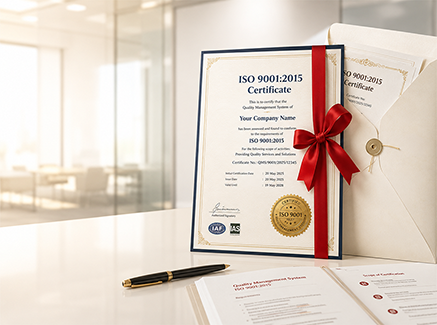
ISO 9001:2015 Certification in the UAE
Build a stronger quality management system, prepare for an independent certification audit and choose the right IAF or non-IAF route for your business requirements in Dubai and across the UAE.
- UAE-wide business support
- IAF and non-IAF guidance
- Documentation and audit-readiness support
What is ISO 9001:2015?
ISO 9001:2015 is an internationally recognised standard for a quality management system, commonly called a QMS. It helps an organisation define consistent processes, assign responsibilities, manage risks and opportunities, monitor performance, address customer requirements and improve the way products or services are delivered.
The standard can be used by organisations of any size and in almost any sector. It does not prescribe one fixed operating model. Instead, it requires your company to establish a controlled, measurable and continually improving system that is appropriate to its activities, customers, legal obligations and business objectives.
Customer Focus
Create more consistent service delivery, manage expectations and respond to feedback using defined processes.
Process Control
Document important workflows, responsibilities, approvals and records so work is less dependent on individual employees.
Performance Improvement
Use objectives, audits, data and corrective actions to identify problems and improve business performance.
Business Confidence
Demonstrate a structured approach to quality when dealing with customers, suppliers, partners and tendering organisations.
Who may need ISO 9001 certification in the UAE?
ISO 9001 certification is commonly requested by customers, corporate procurement teams, project owners, main contractors, international partners and tendering authorities. It can also be adopted voluntarily by a company that wants better process control and stronger operational discipline.
Businesses in Dubai, Abu Dhabi, Sharjah, Ajman, Ras Al Khaimah, Fujairah and Umm Al Quwain may consider certification when they are expanding, entering a new supply chain, bidding for contracts, standardising multiple branches or responding to customer quality requirements.
Common sectors
- Construction, contracting and facilities management
- Trading, distribution, logistics and warehousing
- Manufacturing, engineering and technical services
- Information technology and professional services
- Hospitality, education and business support services
- Healthcare support and specialised service providers
- Companies participating in corporate or government tenders
IAF vs non-IAF ISO 9001 certification
The correct option depends on why your organisation needs the certificate. A tender, customer contract, regulator, international buyer or corporate vendor-registration platform may specify an accredited certificate. Other organisations may need a more limited certification route for internal improvement or a particular commercial requirement.
| Comparison point | IAF-accredited route | Non-IAF route |
|---|---|---|
| Accreditation chain | The certification body is accredited, for the relevant scope, by an accreditation body participating in the IAF Multilateral Recognition Arrangement. | The certificate is issued outside the IAF MLA accreditation chain. |
| Recognition | Generally selected where broader national or international recognition and independent oversight are important. | Recognition can be more limited and depends entirely on whether the receiving customer or authority accepts it. |
| Verification | Certificate and accreditation details may be verifiable through the issuing certification body, accreditation body and, where listed, IAF CertSearch. | Verification normally depends on the issuing organisation's own database or confirmation method. |
| Typical use | Tenders, major contracts, supply-chain qualification, international customers and formal vendor registration where accredited certification is requested. | Internal requirements or specific customer situations where non-IAF certification is expressly accepted. |
| Cost and audit depth | Usually involves a more formal accredited audit process; cost depends on employee count, scope, locations, complexity and readiness. | May be lower-cost, but price should not be the only decision factor because acceptance may be restricted. |
Core ISO 9001:2015 requirements
A company must show that its quality management system is not only documented but also implemented. The external auditor will examine how the system operates in practice, whether employees understand their responsibilities and whether records demonstrate effective control.
Context and Scope
Define the organisation, interested parties, business activities, locations and the scope to be covered by certification.
Leadership and Responsibility
Top management must support the QMS, approve the quality policy, assign responsibilities and review performance.
Risks and Objectives
Identify relevant risks and opportunities, set measurable quality objectives and plan actions to achieve them.
Operational Controls
Control service delivery, purchasing, suppliers, customer requirements, changes, outsourced processes and nonconforming outputs.
Performance Evaluation
Monitor objectives, analyse relevant data, evaluate customer feedback and complete internal audits and management reviews.
Corrective Action and Improvement
Investigate problems, address root causes, verify corrective actions and continually improve the suitability and effectiveness of the QMS.
Documents commonly prepared for ISO 9001 certification
The exact documentation should match the size and complexity of your organisation. Creating excessive templates that employees do not use can make the system difficult to maintain. The goal is practical control, clear evidence and consistent implementation.
- Valid UAE trade licence and organisation details
- QMS scope, organisation chart and process interaction map
- Quality policy and measurable quality objectives
- Risk and opportunity register
- Operational procedures, work instructions and forms
- Employee competence, training and awareness records
- Supplier evaluation and purchasing controls
- Customer feedback, complaints and satisfaction evidence
- Nonconformity and corrective action records
- Internal audit report and management review records
ISO 9001 certification process in the UAE
The following is a typical support and certification journey. The final audit plan and certification decision are controlled by the independent certification body.
Initial Requirement Review
We review your business activity, number of employees, locations, desired scope and the reason certification is required.
IAF or Non-IAF Selection
The intended use of the certificate is checked so that the proposed route aligns with your customer, tender or commercial requirement.
Gap Assessment
Existing processes and records are compared with ISO 9001 requirements to identify missing controls and priority actions.
QMS Documentation
Relevant policies, procedures, registers, forms and process controls are prepared or improved for your actual operations.
Implementation and Internal Review
Your team uses the system, generates evidence, completes an internal audit and conducts a management review before the external audit.
Independent Certification Audit
The chosen certification body conducts its audit. Any findings must be addressed before the certification decision is completed.
How long does ISO 9001 certification take?
There is no responsible one-size-fits-all timeline. A small organisation with clear processes and available records may be ready sooner than a multi-site company with complex operations. Timing depends on the certification scope, employee count, number of locations, existing documentation, implementation evidence, auditor availability and the time needed to close findings.
For an accurate plan, share your trade licence, employee count, business activities, branches and intended certification use.
What determines the ISO 9001 cost?
The quotation can vary based on the type of certification, certification-body audit duration, organisation size, scope, technical complexity, number of sites, consultancy support required and whether your company already has an operating quality system.
To avoid an unsuitable quotation, do not compare price alone. Confirm the accreditation route, certification scope, audit arrangement, certificate verification method and any future surveillance or recertification obligations.
How Tas-heel Center Dubai can support your application
Our role is to help your business understand the requirement, organise the certification journey and prepare practical documentation. We focus on making the process clear for management and employees while coordinating with an independent certification body for the audit and certification decision.
Requirement Review
We examine the intended use, requested wording and available company details before proposing a suitable route.
QMS Preparation
We assist with the structure of policies, procedures, registers and evidence required for an audit-ready system.
End-to-End Coordination
We guide your team through readiness actions, audit scheduling, finding closure and next-step communication.
Not sure whether you need IAF or non-IAF certification?
Send your trade licence, employee count, business activity, number of branches and the tender or customer requirement. We will review the information and explain the appropriate next step without making an unrealistic approval or timeline promise.